Monday, July 22, 2024

One of one hundred, 1972

Songs that enter the Billboard Hot 100 at #100 are obviously at a huge disadvantage when it came to getting airplay and therefore selling records, but a few become unlikely success stories or just have an interesting narrative around them. Here are eight such records from 1972, listed by song title, artist and the date it entered the Hot 100.

Joy – Apollo 100 (1/1/72)

Nut Rocker – Emerson, Lake and Palmer (3/18/72)

Nights in White Satin – Moody Blues (8/5/72)

Somewhere between the Beatles’ studio innovations and the excesses of prog rock, symphonic rock was a trend that mostly affecting British bands. Apollo 100 came up with a rousing, bouncy, harpsichord-driven version of Bach’s Jesu, Joy of Man’s Desiring that hit #6 in the U.S. Emerson, Lake and Palmer, never synonymous with fun, redid Nut Rocker, a sped-up arrangement of Tchaikovsky's The Nutcracker originally done by L.A. studio band B. Bumble and the Stingers (#23 in 1961). A live favorite, and certainly a relief after sitting through concert versions of Pictures At An Exhibition and Tarkus, the single died at #70. The Moody Blues were originally a British Invasion act that leaned heavily on American R&B covers. They disappeared after their 1964 hit Go Now, bought Edwardian suits and a mellotron, then recorded Nights in White Satin with the London Symphony Orchestra. It was their best-selling single, going to #2 in the U.S. 

The Moody Blues

Taxi – Harry Chapin (3/11/72)

Did you know that Taxi is 6:40 long? It feels much shorter, a credit to its production and noirish storyline. Or that Harry Chapin recorded a sequel to Harry and Sue in 1980, called Sequel? (It was something better left alone; Harry should have just kept the change). Chapin’s bass player, John Wallace, sings the soaring falsetto bridge which always felt somewhat reminiscent of the “sail on silver girl” coda to Bridge Over Troubled Water. Taxi stayed on the charts for a long 16 weeks without ever getting into the top 20 (#24). 

Sylvia’s Mother – Dr. Hook and the Medicine Show (4/1/72)

The Cover of Rolling Stone – Dr. Hook and the Medicine How (12/2/72)

Sylvia’s Mother went to #2, Rolling Stone to #6. Both written by Shel Silverstein, who also wrote A Boy Named Sue and someone whose bio includes award-winning children’s book author and Playboy Mansion predator. 

Down On Me – Janis Joplin (7/15/72)

Record companies have no misgivings about releasing, or in this case re-releasing, posthumous recordings. Otis Redding singles and Jimi Hendrix albums released after their deaths were usually weak reminders of past glories haunting the record stores but not the Hot 100. The same fate awaited Down On Me. In 1967 (credited to Big Brother and the Holding Company) it got to #42. This time it only inched up to #91. 

Hi, Hi, Hi – Wings (12/16/72)

This was a mystery when it came out, and not just for impenetrable lyrics about a “sweet banana” and a “body gun,” although Paul McCartney swore he’s singing “polygon” there, which doesn’t make much sense either. The song felt too loose, chaotic, to be the usually precise McCartney production unless he was having flashbacks to Helter Skelter. Thanks to the title, the obligatory banning by the BBC followed as the song went to #5 in the U.K. and #10 in the U.S.

Friday, June 28, 2024

Tubi clearance sale

Three movies that I’d bookmarked for future viewing on Tubi were about to depart the channel, so I had to move them up in my queue and watch them quickly.  

I’m not sure why Robert Altman’s The Long Goodbye (1973) begins and ends with “Hooray for Hollywood” – it folds into the "L.A. Noir" category, but much of it takes place in Malibu and Mexico, with no mention of films or filmmaking. 

Elliot Gould plays the venerable private detective Philip Marlowe with an insouciant charm, a hipster anti-hero and the only character in the film who wears a business suit, even on the beach, smokes (constantly, striking wooden matches on any flat surface within reach), or has zero interest in a sorority of potheads who practice topless yoga on the balcony across from his apartment.


If you're looking for Altman’s sometimes leftfield casting, The Long Goodbye includes Jim Bouton, with a pivotal role (but thankfully few lines), and Nina van Pallandt, a 1970 headline maker thanks to her role in the silly 1970 Clifford Irving-Howard Hughes “scandal.”

Toss in the excellent Gould, Sterling Hayden playing to type as a blocked Hemingwayesque writer and Henry Gibson, going against the grain as a tough-guy, and you have the best of the post-Bogart Philip Marlowe movies.

The social order within the Rat Pack is never more apparent than in Salt and Pepper (1968). Frank Sinatra and Dean Martin share top billing in a drama like Some Came Running; Peter Lawford and Sammy Davis get stuck with this comedy (which they co-produced) about nightclub owners in “Swinging London” who find themselves involved in stopping a military coup of the U.K.

Sammy isn’t just the co-owner of the club, he’s also the nightly entertainment, and gets a big song and dance number, frugging and whipping off a “solo” on an electric guitar that isn’t plugged in. He only needed to wait a year for his real shot for a big number in a big movie, The Rhythm of Life in Sweet Charity.


A fascinating subtext throughout, knowing how Lawford and Davis died, is watching them forever lighting up, smoking or having a cigarette smoldering between their fingers. There’s no oxygen tank assistant listed in the credits, but that doesn’t mean there wasn’t one.

One year after Dirty Harry comes Hickey and Boggs (1972), with Robert Culp and Bill Cosby menacingly pointing big guns. This is one dark and brutal movie. Culp (who directed) and Cosby play private detectives financially and emotionally at the end of the line. As a disillusioned Cosby says, “There’s nothing left of this profession. It’s not about anything.”

But even as both are prone to confusion about their identity, purpose and meaning in life, they also buoy each other.

The plot is somewhat convoluted, but a missing person case leads to a string of deaths (a lot of deaths) and shootouts (including a firefight in the parking lot of Dodger Stadium and on the field of the Los Angeles Coliseum).

Professional hitmen, Black Power nationalists, dark bars at midday, Mexican immigrants, sunbaked urban settings – as a noir movie about the “seamy underbelly” of Los Angeles in the 1970s, Hickey and Boggs is an underrated gem.

Thursday, June 13, 2024

Stuck a feather in his hat

Friedrich Wilhelm Steuben (AKA Baron von Steuben) was born into a Prussian military family in 1730. He enlisted in the Prussian Army as a teenager and put in 17 years of military service, rising to the rank of captain. He was abruptly discharged in 1763, then spent 11 years as a private citizen.

But Steuben yearned for military life and when Benjamin Franklin made overtures to have him join the Revolutionary War and help lead an inexperienced army of farmers on its heels battling far superior British troops, he jumped at the chance.

Working without compensation, Steuben arrived in the colonies to find a ragged and undisciplined Continental Army. He established military drills, paid attention to housekeeping details like placing latrines and mess halls on opposite ends of encampments, and taught battle tactics unknown to the colonials, like how to use a bayonet in close-quarter combat. 

Now prepared and battle-ready, the war shifted in the favor of the colonials. Steuben won over George Washington, becoming a trusted advisor.

Baron von Steuben was also apparently openly gay at a time when the term “homosexual” had yet to be invented and “gay” meant something else entirely.

Steuben remained unmarried his entire life and there is no mention of female companions in any of his correspondence. He took on several long-time companions, younger men who served as aides-de-camp and translators (Steuben spoke no English, only profanities). At Valley Forge he met two officers in their twenties, William North and Benjamin Walker, and legally adopted them as his “sons,” able to inherit his estate, a common practice before gay marriage was legal.

There is also a story that at Valley Forge Steuben organized, at his own cost, a dinner party for the troops, demanding everyone who attend be nude or in their underwear. Maybe it was his way of saying that rank didn’t matter, we’re all the same underneath. Maybe not.

Steuben may have been openly gay, but the specter of sodomy laws were always present, with a maximum penalty of death in Virginia. (Thomas Jefferson tried to reduce it to "simply" castration).

With the war over, Steuben was discharged with honor, became a U.S. citizen and a thankful New Jersey presented him with the use of an estate, known as Steuben House, located in New Bridge Landing (today River Edge). The home had been confiscated from a Brit loyalist and it served briefly as George Washington’s military headquarters. Steuben and William North lived together there for several years before Steuben moved to New York State, where he died in 1794.

You can become blasé growing up so close to history – Google Maps says it’s a 23-minute walk from where I grew up to Steuben House – but thanks to many school trips, Baron von Steuben was as familiar a name to us as George Washington or Alexander Hamilton. The place always had a ghostly presence, sitting as it did among busy roadways and faceless garden apartments (named The Steuben Arms).

Ironically, it’s also just a half mile away from another New Jersey landmark. Club Feathers opened in 1978, making it the state’s oldest gay nightclub and currently the only one in North Jersey. Its a place where, according to one online review, people can feel safe, welcome and accepted. 

Sounds like the kind of place Baron von Steuben might have liked hanging out in.

Much of the historical information about Steuben is taken from “Washington’s Gay General,” a graphic novel written by Josh Trujillo and illustrated by Levi Hastings.


Friday, May 24, 2024

One of one hundred, 1965 

Songs that enter the Billboard Hot 100 at #100 are obviously at a huge disadvantage when it came to getting airplay and therefore selling records, but a few become unlikely success stories or just have an interesting narrative around them. Here are seven such records from 1965, listed by song title, artist and the date it entered the Hot 100.

Whipped Cream – Herb Alpert’s Tijuana Brass (2/20/65): The title cut of the ubiquitous album whose cover mesmerized us kids who frequented record stores. There’s a video on YouTube featuring one those guys who go around haunting thrift shops and garage sales for records showing off the literally dozens of copies of this album that he's picked up over the years. Never to be confused with Pat Cooper’s excellent parody.


The Mouse – Soupy Sales (4/24/65): Even with Soupy promoting the song (and dance) on Ed Sullivan, The Mouse wasn’t the national hit that I thought it was, only charting up to #76, but it hit #6 on New York City radio (WABC). The Mouse wasn’t much of a dance, mostly a lot of face-twitching but it was even easier to do than the Twist.

From A Window – Chad & Jeremy (7/10/65): From a Window was written by Paul McCartney, attributed to Lennon- McCartney, and a big hit for Billy J. Kramer with The Dakotas. For some reason, World Artists thought it would be a good idea to release Chad & Jeremy’s cover less than a year later; it peaked at #97. 

The “In” Crowd – Ramsey Lewis Trio (7/31/65): The Ramsey Lewis Trio featured Lewis on piano, drummer Redd Holt and bassist Eldee Young. The In Crowd reached #5 on the Billboard Hot 100, sold more than one million copies, won a Grammy and gave Lewis entrée to record a slew of jazzed-up pop songs (A Hard Day’s Night, Hang On Sloopy, Wade in the Water), and a music career model that guitarist Wes Montgomery tried to follow, but with much less success. Holt and Young formed their own Young-Holt Unlimited and had a hit record with the Ramsey Lewis soundalike, Soulful Strut.   

What Are We Going To Do – David Jones (8/14/65): David Jones was from Manchester when it was cool to be a Brit, personable, photogenic and had a singing contract with the record company for Columbia Pictures–Screen Gems. As Davey Jones, he was an easy call to be cast as one of the Monkees. 

Jenny Take A Ride – Mitch Ryder & the Detroit Wheels (12/11/65): Second only to You Lost That Lovin’ Feeling as the year’s best white soul record. 

Uptight – Stevie Wonder (12/18/65): One of Motown’s signature songs with a horn riff said to be inspired by Satisfaction and 15-year old Stevie’s committed vocal. Why this didn’t debut any higher on the charts is a mystery. Maybe Motown was spending most of its resources promoting the Supremes?

Wednesday, May 15, 2024

The List of Adrian Messenger

(This post is part of the It’s In the Name of The Title Blogathon hosted by Reelweegiemidget and Taking Up Room)

The List of Adrian Messenger is one of those Golden Age of Detective Fiction yarns that revolve around gathering clues and solving crimes as if they were puzzles. The plot is a bit convoluted, as it relies on an improbable coincidence or two, but essentially the list in question contains the names of people whose seemingly unrelated accidental deaths Adrian Messenger believes are in truth linked murders. He asks a friend, a retired MI5 agent (George C. Scott) to investigate.

As it turns outs, there’s a killer murdering his way to a royal title and the regal manor that goes with it, wearing several elaborate disguises to hide his identity. “One man who becomes many men,” is how Scott’s character puts it.

The List of Adrian Messenger was George C. Scott’s fourth movie and first as a good guy. He doesn’t have any scenery-chewing scenes as in Patton or The Hospital, but he maintains a reserved conviction and clipped accent that never wavers even when he’s muttering clues to himself. He’s downright Holmesian in his doggedness and attention to the smallest details.

This is a mannered production; all the characters are courteous to a fault, somewhat chilly and distanced, and there’s a climactic fox hunt that ends with a gruesome death by farming machine. Today, the film is probably best remembered for the novelty of casting five of the era’s most recognizable actors – Tony Curtis, Kirk Douglas, Burt Lancaster, Robert Mitchum and Frank Sinatra – each heavily disguised, allowing audiences to guess at just who was playing whom.

In the movie’s epilogue each actor pulled off their prosthetic latex pieces and spirt-gummed hair for five big reveals. But the real revelation was that only Douglas, Mitchum and Curtis appeared in the actual film, with Lancaster and Sinatra just participating in the finale. Uncredited actors played their roles with voices dubbed in by versatile voice actor Paul Frees.

Guess who?

“It wasn’t grand theft, but it was pretty close,” admitted John Huston, the film’s director. But what Huston did cook up was a movie that was winkingly self-referential, a disguised killer lurking among a cast of disguised actors. The List of Adrian Messenger was meta before there was meta.

In a larger sense, this movie, along with The Seven Faces of Dr. Lao (released a year later with Tony Randall hiding behind all seven faces) were among the first to acknowledge the bizarre make-up jobs that are central to each film by giving them prominence on their posters. And maybe in their own way helping trigger an interest in movie special effects that has only grown since.

Not to mention that whenever Rollin Hand (Martin Landau) pulled off yet another latex-face disguise to acknowledge the successful completion of a Mission: Impossible adventure the show was – whether intentionally or not – hearkening back to The List of Adrian Messenger.

This movie is a curio, but one worth checking out.

Monday, May 6, 2024

One of one hundred, 1968

Songs that entered the Billboard Hot 100 at #100 are obviously at a huge disadvantage when it comes to getting airplay and selling records, but a few become unlikely success stories or just have an interesting narrative around them. Here are eight such records from 1968, listed by song title, artist and the date it entered the Hot 100.  

A Tribute to a King – William Bell (4/27/68) Despite the timing and title, this isn’t about Martin Luther King, but Otis Redding. Redding and William Bell both recorded for Stax Records, located several blocks from the Lorraine Motel where King died. Black musicians often stayed there; it’s where Steve Cropper and Eddie Floyd stopped by Wilson Pickett’s room and wrote In the Midnight Hour. 

Here Comes The Judge – The Magistrates (6/1/68) One of three songs that entered the charts this week with the same title, one of those weird cultural moments that happened when everybody watched the same TV shows. The Magistrates’ record died quickly while Shorty Long’s (also released that week) went to #8. Two weeks later Pigmeat Markham's (who originated the judge routine in the chitlin’ circuit) version came out, which today sounds like the first rap record. 

Soul Meeting – The Soul Clan (7/27/68) The Soul Clan – a name that was probably picked quite purposefully – consisted of perennial soul music contenders Solomon Burke, Don Covay, Joe Tex, Arthur Conley and Ben E. King. They asked Atlantic Records for a $1 million advance, envisioning seed money to buy real estate in black neighborhoods and helping black-owned businesses. Atlantic balked, the idea fizzled out and the group recorded this one single. 

On The Road Again – Canned Heat (8/10/68) In 1968 you could get away with recording country blues against the background of a droning Indian tamboura. Canned Heat had two hit singles and recorded several albums that blended into one boogie-fest that all sounded the same. Thanks to the appearance of lead singer Bob “The Bear” Hite, who looked every bit of that nickname, Canned Heat was featured in the Monterey Pop and Woodstock films. 

Fly Me To The Moon – Bobby Womack (8/17/68) In those endless online debates about who does and doesn’t belong in the Rock & Roll Hall of Fame, nobody ever brings up Womack – possibly because no one knows he was inducted or what he did to get there. 

Naturally Stoned – The Avant Garde (8/31/68) Fluffy pop written by future conservative radio host and anti-vaxxer Chuck Woolery. 

Lady Madonna – Fats Domino (9/7/68) Fats Domino covers Paul McCartney’s Fats Domino homage. 

Ride My See-Saw – The Moody Blues (10/12/68) Beyond the flutes, mellotrons and drippy poetry/lyrics, The Moody Blues did occasionally know their way around a song that rocked.

Thursday, April 25, 2024

Feeling a draft 

From my first days as a football and New York Giants fan, I realized the importance of the college draft. 

In 1971, I was home from school for some reason and desperate for an update on the NFL draft being conducted that day. Nothing on WINS, the news station, or WNEW, “home of the New York Giants” – only Knicks and Rangers scores from the night before. It wasn’t until the 5 p.m. news on WNEW that I learned that the Giants’ first round pick was, and this is as it was announced, Ralph “Rocky” Thompson of West Texas State. Wait, we took a guy named Ralph? West Texas State? 

Draft coverage in our local newspaper The Bergen Record was pathetic: a list of teams with names underneath. I needed to know who got picked, by which team and in what round. In order. I began buying The New York Times on the day following the draft, with its complete listing in order, cryptic shorthand explaining the lineage of each pick, traded from one team to another. At one point in the 80s, with the draft occurring while we were visiting Florida and with The Times nowhere in sight, I found that USA Today gave a similar recap. 

The Times draft posting was valuable enough that at one point, I went through back editions at our city library on an ancient microfilm viewer with dials you turned to advance each page and made copies of previous drafts. 

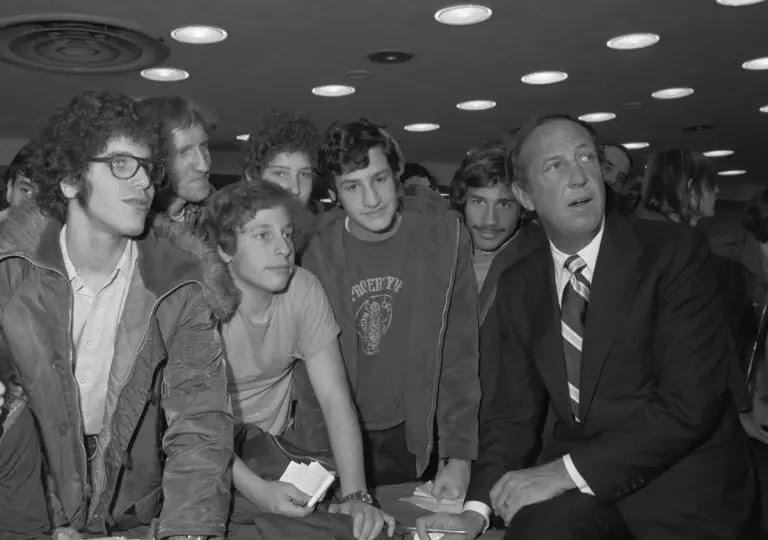
The NFL opened its doors to the proceedings to spectators at some point, and in 1975 I drove to midtown Manhattan, and with absolute faith in my ability to parallel park my Toyota Corona into the tightest spaces possible, found a spot on the street and attended the draft at the New York Hilton. Sitting in the ballroom balcony, I stayed for an hour or two; my recollection is hazy. I remember Pete Rozelle announcing a couple of first-round choices, and I took a sheet that the NFL passed out detailing the trades that had been made thus far that morning. One of those things I wish I’d held on to. 

Rozelle and fans at the 1975 draft

In 1980 ESPN began broadcasting the draft live. When I was reading meters, I could track the draft’s progress, house by house, sneaking a peak at televisions tuned to ESPN or in a quick conversation with a customer. Much later, on a business trip to Detroit, I put the draft on the hotel TV, fell asleep, then woke up in the middle of the night with the first round well over. 

I won’t fall asleep in front of the TV tonight, but once the Giants make their pick, I’ll head for bed. And the journey of how we get our news keeps changing. With the draft now broadcast on something like eight different channels and services, and online coverage eating up as many column inches and megabytes as a presidential election, there’ll be no need to buy tomorrow’s Times.